


Unlocking New Research Possibilities: University of Wyoming Researchers Use Bolin PTZ Cameras to Advance Wildlife Studies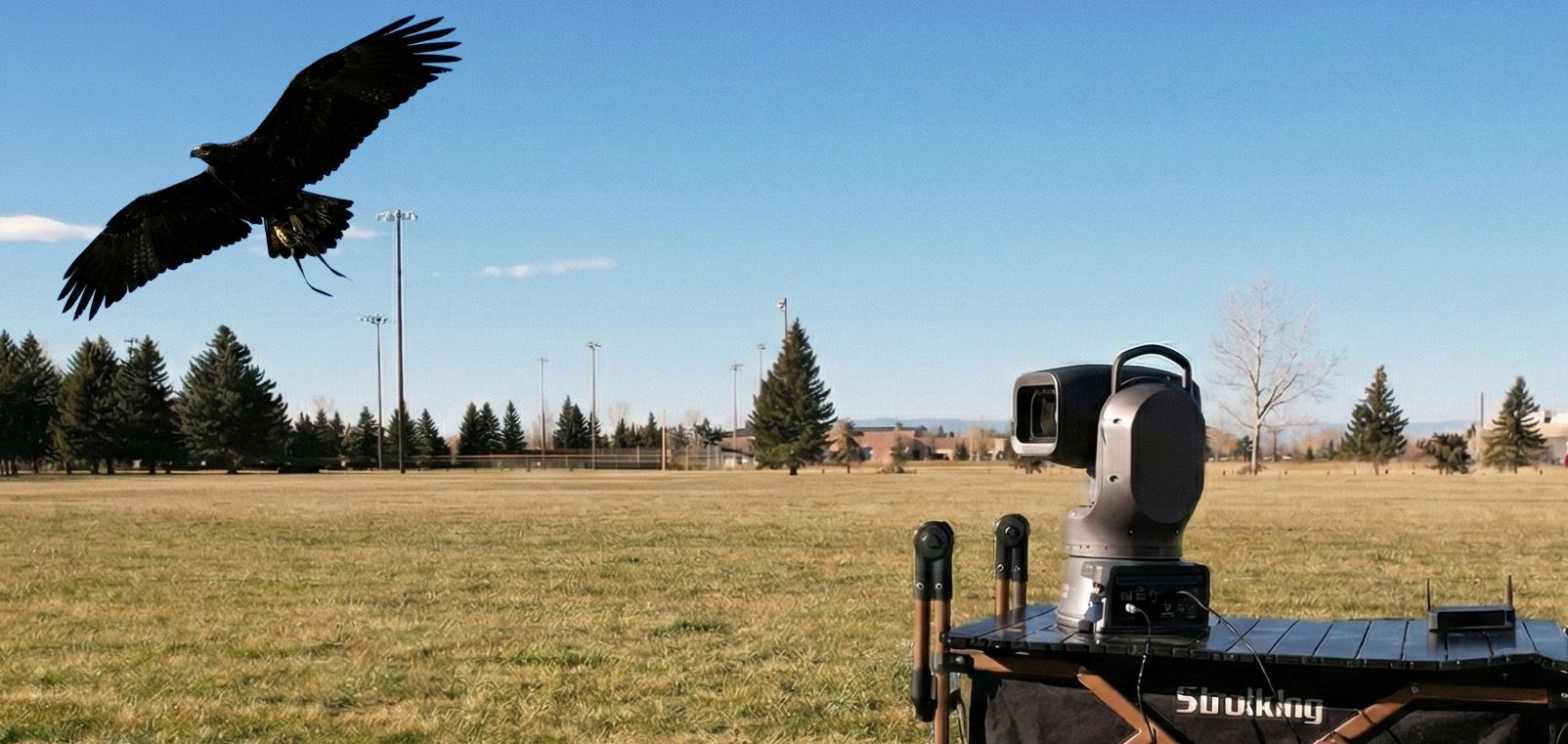
At the University of Wyoming’s School of Computing, researchers are applying advanced technology to better understand the natural world. As part of a collaboration with the Teton Raptor Center, Dr. Jian Gong and his colleague Dr. Ellen Aikens are contributing to a research project focused on observing Golden Eagles and studying their behavioral patterns in their natural habitats.
Dr. Gong, a research scientist specializing in computer vision, sensor networks, and spatial acoustics, supports the team’s technology development efforts by integrating artificial intelligence and imaging systems into the research workflow. The goal is to capture and analyze high-quality visual data without disturbing the eagles in the field.
While this specific project represents a new application for Bolin cameras at the University of Wyoming, the institution itself is not new to Bolin. The university has used Bolin cameras in previous academic and media initiatives, contributing to its familiarity with the brand’s reliability and imaging performance.
The Challenge
Golden Eagles are known for their remarkable vision and sensitivity to movement, sound, and scent, which makes direct observation difficult. Traditional methods, such as manual observation, stationary camera traps, or binocular studies, often disturb the birds or fail to deliver the image precision needed for behavioral research.
The research team needed an imaging system that could operate from long distances, provide precise movement control, and integrate seamlessly with AI models for automated tracking. It also had to be adaptable for use in both field and lab environments, giving researchers full control through programmable interfaces.
“We wanted a system that could observe and analyze wildlife behavior automatically,” said Dr. Gong. “That required cameras with strong imaging performance and an open interface that we could integrate into our own research workflows.”
Delivering the Solution
To meet these needs, the team selected Bolin’s EXU248N PTZ cameras for their imaging clarity, smooth motion control, and integration flexibility through Bolin’s API. The cameras were integrated into a workflow that combines AI-based object detection, NDI video transmission, and custom control scripting.
Using NDI 6 and Bolin’s API, the team built a Python-based automation environment capable of detecting and tracking eagles in real time. The system employs YOLO-series machine learning models for visual detection, while custom PID scripts convert the AI’s output into PTZ camera commands for smooth, responsive movement.
“My student, Iqbal Hossain, developed much of the AI workflow,” explained Dr. Gong. “We used the camera’s control interfaces to manage PTZ movement directly through our code, which gave us the flexibility to customize how the system tracks and records each target.”
The workflow supports both local and remote operation, using large AC power banks, local network access with NDI apps on mobile and tablet devices, and satellite internet such as a Starlink Mini terminal for remote access. This allows researchers to monitor, record, and adjust the cameras without needing to be physically present near sensitive observation sites.
The team is currently using drones to simulate aerial movement and refine the AI-driven tracking process. These drone-based tests help validate the algorithms and control systems before they are applied in the field for real-world eagle tracking.
Results and Benefits
Although the project is still in its early stages, initial results have been highly encouraging. The integration of Bolin’s PTZ cameras has allowed the team to begin capturing and analyzing detailed imagery that supports their automated tracking research. The clarity, precision, and responsiveness of the cameras have made them an excellent fit for this AI-based workflow.
“The image quality and control response have been excellent,” said Dr. Gong. “It works exactly as we need for our AI workflow and has given us the ability to capture natural behavior without interference.”
The research team continues to test how the camera system, power infrastructure, and network connectivity perform together in remote conditions. These ongoing field tests are helping refine both the hardware setup and the software algorithms to achieve reliable autonomous operation.
By leveraging Bolin’s API, the team has full flexibility to refine and expand their AI-based observation tools. The cameras’ API allows researchers to develop custom functionality, integrate with open-source tools, and create new control applications for specialized workflows.

Looking Ahead
As the project progresses, the University of Wyoming team plans to conduct additional field testing, optimize their algorithms, and expand their system to support long-term observation. Once validated, they aim to publish portions of their open-source software for other researchers working on similar applications.
“We are still testing the algorithms, power systems, and network to make everything work together,” said Dr. Gong. “It’s early in the process, but so far it feels very promising. We see this as a foundation for future research, and Bolin’s cameras provide the flexibility and reliability we need to keep improving how we collect and analyze data.”
By combining imaging, AI, and network-based control, the University of Wyoming continues to demonstrate how advanced video technology can serve as a valuable tool for scientific discovery and education.